
International Center for the Scientific Development of Shrimp Aquaculture (ICSDSA)
International Center for the Scientific Development of Shrimp Aquaculture (ICSDSA)
Han-Ching Wang
Research Center
International Center for the Scientific Development of Shrimp Aquaculture (ICSDSA)
An-Nan Campus
International Center for the Scientific Development of Shrimp Aquaculture (ICSDSA)
I-Hua Chen
ihua@mail.ncku.edu.tw
06-2757575 ext.58209
In Phase II, the center will further develop precision and sustainable aquaculture technologies and apply them in practical aquaculture settings, strengthening ICSDSA’s competitiveness in the global shrimp industry. The team remains focused on three core directions: (1) enhancing P. monodon genetic breeding and smart aquaculture to boost commercial value; (2) collaborating with academia and industry to develop AI-integrated farming systems; and (3) contributing to global shrimp disease prevention while training the next generation of aquaculture health professionals. In 2025, ICSDSA will also host the 5th Conference of the International Society of Fish and Shellfish Immunology (5th ISFSI), inviting 200 participants from 10 countries.
Key achievements in 2024 include: (1) We successfully operated the Annan Nuclear Breeding Center and Hualien Growout Facility, producing Taiwan's only non-governmental SPF high-quality P. monodon) broodstock and post-larvae. This year, we selected 9 elite families, generated 14 batches of superior offspring, and selected 475 broodstock, producing a total of 847,000 post-larvae—2.5 times more than last year. Reproductive performance continued to improve, and Hualien Center harvested 1,300 kg of shrimp and over 1,000 mature broodstock above 100g. (2) To achieve precision aquaculture, we collaborated with leading institutions in information technology and imaging to develop AI-based shrimp larval and algae monitoring systems, the world’s first AI reproductive maturation assessment system, and a growth-tracking system for broodstock. Trial runs for these systems are planned for 2025. (3) We continues to lead the two WOAH-recognized reference laboratories for shrimp diseases (AHPND and WSD), maintaining ISO 17025 accreditation and providing high-quality diagnostic services. Our team actively participates in the WOAH crustacean ad hoc group, contributes to international standard setting, and serves as advisors to Taiwan's Ministry of Agriculture for disease diagnostics and policy. (4) We are organizing the 5th Conference of the International Society of Fish and Shellfish Immunology (5th ISFSI) Conference—the first time held in Asia—scheduled for 2025, with participants from 10 countries and ~200 attendees expected. For international collaborations, we initiated collaborative projects and training exchanges with partners in the U.S., Philippines, Japan, and Malaysia, hosted visiting scholars, delivered 2 invited talks, and won 14 presentation awards, highlighting our team’s global competitiveness. Combining scientific strength with unique infrastructure, the ICSDSA plays a key role in driving innovation, industrial application, and international collaboration in Taiwan's shrimp industry. We remain committed to improving P. monodon genetic breeding, developing precision and smart aquaculture models, and accelerating commercialization for industrial modernization.
Rooted in research excellence, we foster student and researcher engagement in global forums and disease control initiatives. Our integrated breeding and research platforms span from molecular to organismal levels, drawing interest from academia and industry. We continue to generate impactful scientific outcomes and practical applications. Moreover, we offer hands-on learning environments that immerse students and young professionals in biosecurity and technical operations. Through this integration of science and practice, we aim to bridge education and industry needs, enhance talent development, and promote sustainable aquaculture for the benefit of society and the global seafood industry. By integrating strong science with unique field resources, ICSDSA is advancing research translation, international cooperation, and sustainable shrimp farming.
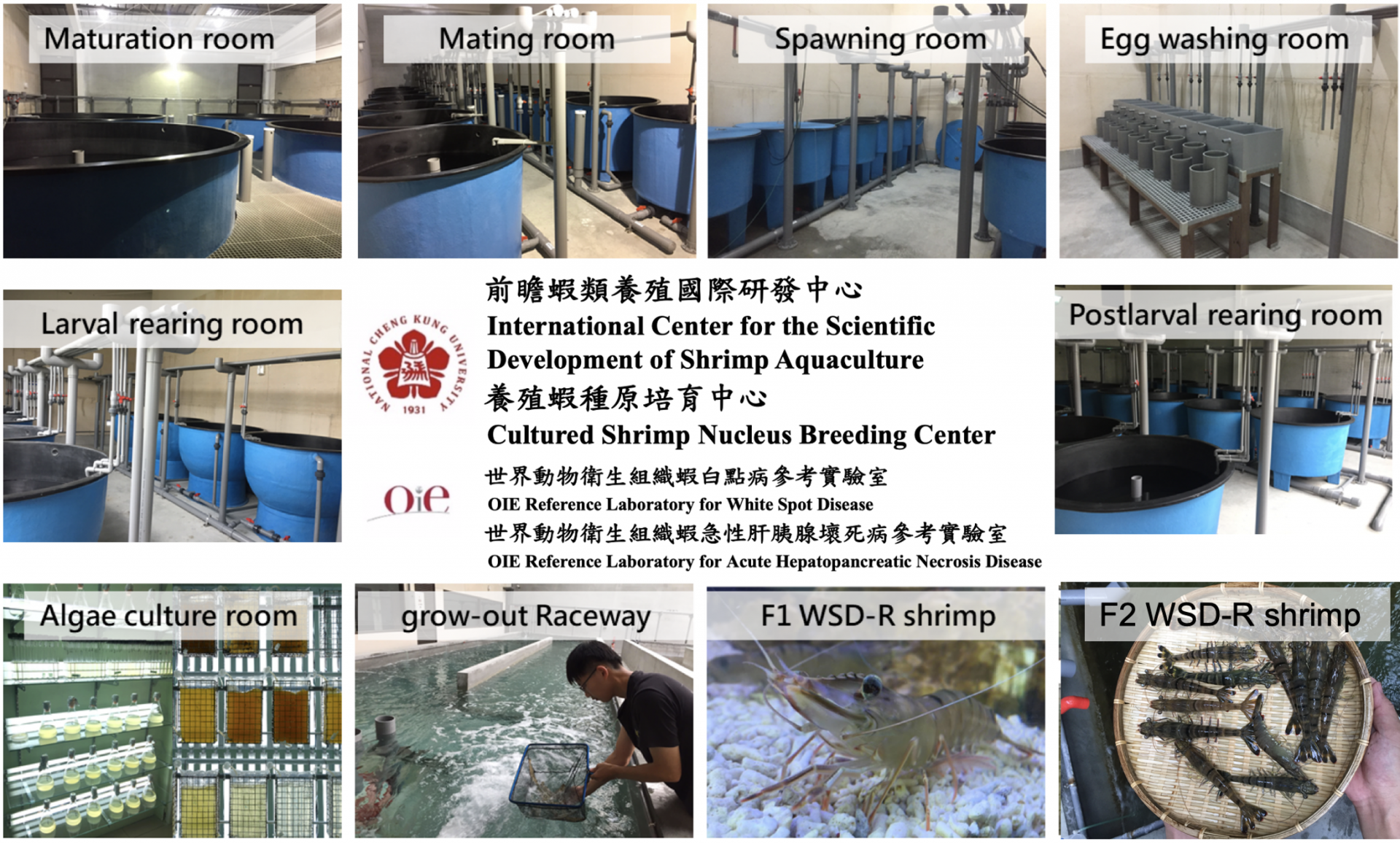
1. Successfully operated the Annan Nuclear Breeding Center and the Hualien Growout Facility, both producing SPF P. monodon broodstock and post-larvae (PL).
2. Maintained and continuously cycled 17 offspring lines from 12 P. monodon families (including one newly developed hybrid family), selecting 9 families with desirable commercial traits and producing 14 batches of high-quality offspring.
3. A total of 475 P. monodon broodstock were selected from Annan and Hualien facilities for further breeding and genetic conservation at the Annan Nuclear Breeding Center. This year, approximately 847,000 P. monodon post-larvae were produced (170,000 PLs supplied from Annan to Hualien for grow-out; 677,000 PLs used in field trials at NARL and commercial farms), a 2.5-fold increase compared to 2023 (334,000 PLs). These PLs, derived from selectively bred families, demonstrate competitive growth rates and survival.
4. In 2024, 75 P. monodon broodstock in the Annan Nuclear Breeding Center successfully spawned, representing a 10% increase compared to 2023.
5. Average egg production per broodstock reached 520,000 eggs (up from 500,000 in 2023, +4%), with fertilization rates reaching as high as 59% (compared to 55% in 2023), showing the continuous success of selecting highly fecund broodstock to meet industry demands.
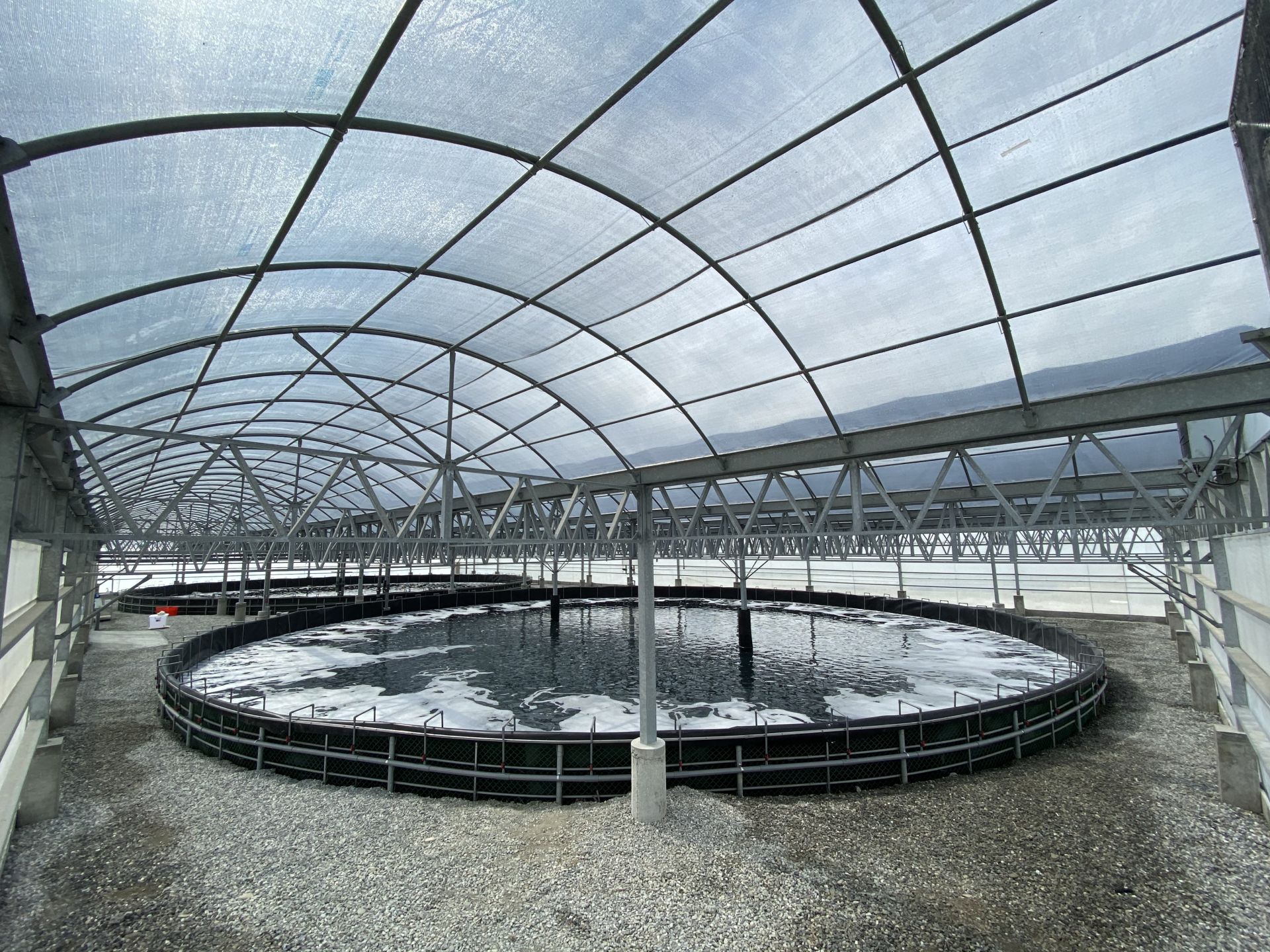
6. While the center mainly focuses on conservation breeding, the Hualien Grow-out Center harvested approximately 1,300 kg of P. monodon in a 3-hectare area in 2024, accounting for about 0.4% of Taiwan's total production. Additionally, over 1,000 broodstock weighing over 100 grams were successfully reared, supporting commercial application of optimized breeding lines.
7. All shrimp cultivated at the Annan Nuclear Breeding Center and Hualien Growout Facility are SPF for five major pathogens (WSSV, IHHNV, YHV, EMS, and EHP). The polychaetes used for broodstock maturation feeding (Dutch red worms) are also certified free of at least eight pathogens (WSSV, IHHNV, YHV, EMS, EHP, MBV, TSV, and IMNV).
8. The Annan Nuclear Breeding Center successfully developed an AI-based model for ovarian maturation detection in broodstock. In 2024, the platform was established, integrating reproductive-stage prediction, broodstock digitization, real-time monitoring, and early warning systems. This globally pioneering platform is scheduled for trial operation in 2025 and attracted strong industry interest during international conference presentations.
9. The Hualien Growout Facility established an AI-based aquaculture management system incorporating the AR-YOLOv5 object detection model to identify shrimp based on shape and orientation. It cross-references historical observation data to support routine monitoring and analysis. Shrimp growth curves and related data are integrated into a web-based platform for real-time monitoring and industrial application.
10. Collaborating with interdisciplinary teams from NCKU, the center contributes to net-zero initiatives. Efforts include building a microalgae-based carbon reduction platform, developing high-strength porous geopolymers from low-cost natural minerals for ammonia removal, and creating an optical detection device for shrimp size and number estimation. These technologies aim to reduce the center's overall carbon footprint and support sustainable aquaculture.
11. Continued operation of two WOAH reference laboratories established at the center for shrimp Acute Hepatopancreatic Necrosis Disease (AHPND) and White Spot Disease (WSD), both ISO 17025 certified and providing professional diagnostic services.
12. Actively serving as a member of the WOAH Crustacean ad hoc group to assist in reviewing and revising global standards for crustacean disease control.
13. Serving as a member of the Animal Quarantine Subcommittee under the Ministry of Agriculture’s Animal Health Advisory Committee, providing expert consultation on shrimp disease diagnostics.
14. Preparing to host the prestigious international conference “5th Conference of the International Society of Fish and Shellfish Immunology (5th ISFSI)” in November 2025, supported by NSTC. This event will be held in Asia for the first time, featuring outstanding researchers from 10 countries and an expected attendance of approximately 200 participants.
15. Prof. Chu-Fang Lo was listed among the “World’s Top 2% Scientists” for both the 2023 scientific impact ranking and the lifetime ranking (1960–2023). Prof. Han-Ching Wang received the GenMont Biotech Young Scholar Award.
16. Promoted multiple international collaborations (Philippines, Japan, Thailand, U.S., Malaysia, Korea), sending 5 members for overseas industry internships, 2 members to the U.S. WOAH Reference Lab for diagnostic training, and hosted 2 benchmark center representatives and 4 other senior international researchers for in-Taiwan research exchanges.
17. Young researchers from the center were invited as speakers at 2 international conferences (2 invited talks). 18. Student members of the team participated in
18 instances of international conferences, receiving 5 awards, and 16 instances of domestic conferences, receiving 9 awards.


 Sweepstake